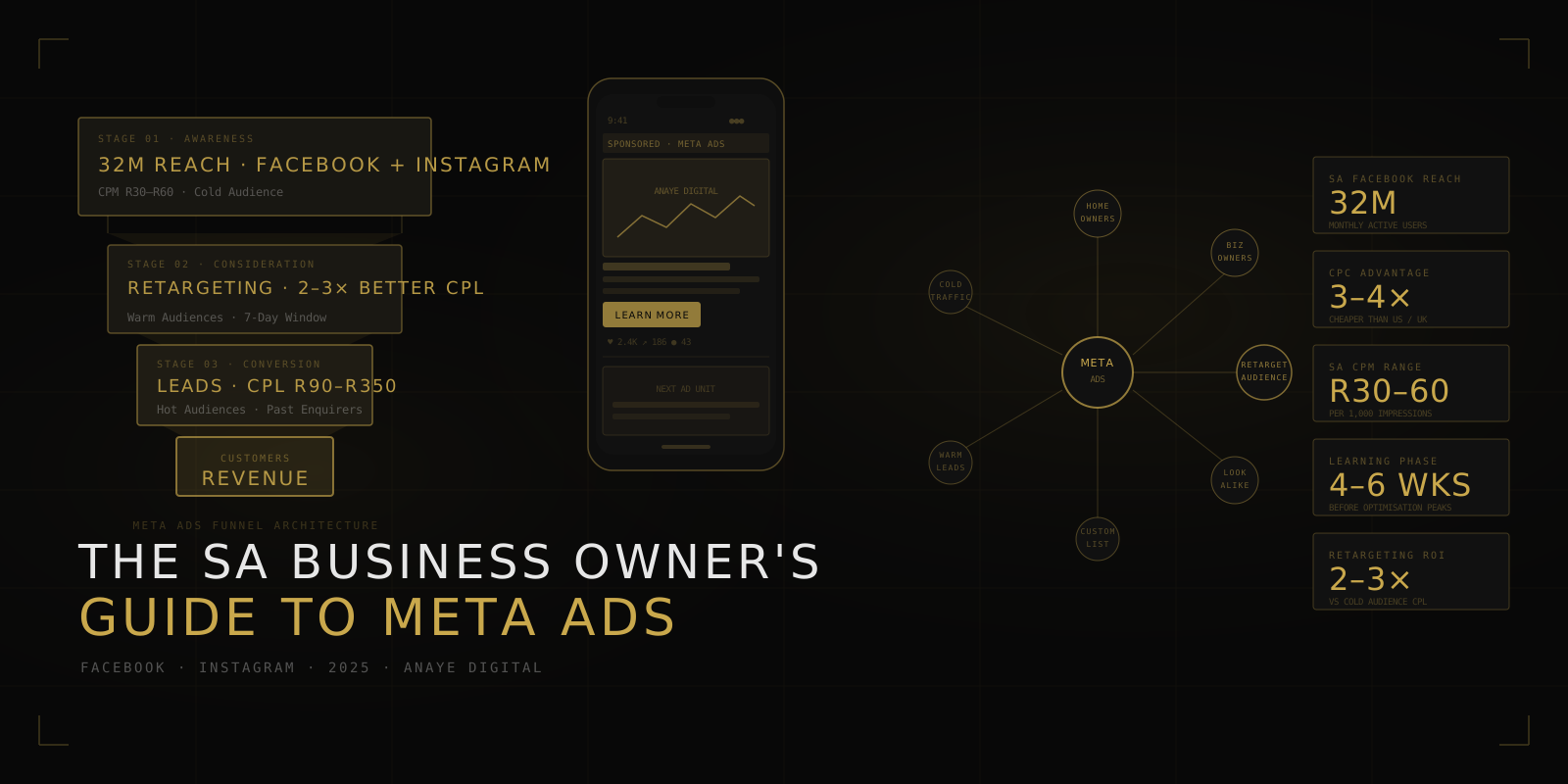
Thirty-two million South Africans are on Facebook. Eight million are on Instagram. Their data is visible to advertisers at a level of demographic and behavioural precision that no traditional media channel comes close to. And the cost of reaching them is three to four times cheaper per click than equivalent audiences in the US or UK. Meta advertising in South Africa is one of the highest-leverage paid media channels available — and most SA businesses are running it badly.
Why Meta Is Different From Every Other Channel
The fundamental distinction that changes everything about how you approach Meta advertising: Google captures demand. Meta creates it.
When someone searches "accountant Pretoria" on Google, they have a declared need. Your ad intercepts that need. The intent is theirs — you're just showing up at the right moment. On Meta, nobody is searching for your service. They're scrolling through photos, news, and videos. Your ad interrupts that experience. The prospect has no declared need, no active search, and potentially no awareness that your business exists.
This is not a weakness. It is a structural difference that demands a fundamentally different strategy. Meta excels at three things that Google cannot do: reaching people before they know they need you, building the brand familiarity that makes your Google ads convert better, and re-engaging warm prospects who visited your site or engaged with your content but didn't convert. Understanding this distinction is the difference between treating Meta as a worse version of Google and treating it as a complementary channel that makes your entire marketing ecosystem more efficient.
Google captures the customer at the moment of need. Meta creates the customer before the need exists.
— Anaye Digital Paid Social TeamFacebook vs Instagram: What SA Data Shows
Meta's advertising platform manages both Facebook and Instagram from a single Ads Manager interface. But they are distinct audiences with different demographics, different content formats, and different conversion behaviours. The SA data is clear on how they differ:
The practical implication for most South African service businesses: Facebook is your primary conversion platform, Instagram is your primary discovery and brand-building platform. If your budget is under R5,000 per month, focus on Facebook. Above R5,000, run both through Meta's Advantage+ placements and let the algorithm optimise delivery between them — but review placement-level data regularly to ensure budget isn't being absorbed by low-converting Audience Network inventory.
What Meta Ads Actually Cost in South Africa
One of the most common reasons South African businesses abandon Meta advertising prematurely is a misalignment between expected costs and actual costs. Here are realistic 2026 benchmarks for SA campaigns across different objectives and industries:
Stay Ahead of the Curve
Practical digital marketing insights for marketers and business owners — no fluff, straight to your inbox.
| Metric / Category | SA Benchmark Range (2026) | Notes |
|---|---|---|
| CPC — Traffic campaigns | R5–R25 | Lower end for broad audiences, higher for narrow professional targeting |
| CPM — Awareness campaigns | R15–R80 | R30–R60 typical for homeowner/property-owner demographics |
| CPL — Home services | R90–R350 | Varies heavily by service type, audience quality, and landing page CVR |
| CPL — Financial services | R150–R500 | Higher intent required; longer consideration period |
| CPL — eCommerce | R40–R180 | Cost per purchase (not lead); varies by product and ticket value |
| CPL — B2B lead gen | R200–R600 | LinkedIn often more efficient for high-ticket B2B; Meta better for SME B2B |
| Retargeting CPL | R40–R150 | Warm audiences convert at 2–3× the rate of cold traffic |
| Minimum viable budget | R3,000–R5,000/mo | Below R3,000, the algorithm has insufficient data to optimise |
The two-part cost equation that confuses most business owners: Meta advertising costs are your ad spend (what you pay Meta per month) plus your management fee (what you pay an agency or freelancer to run the campaigns). These are entirely separate. A R5,000 monthly ad spend budget does not include management. Professional Meta management in South Africa typically costs R3,500–R8,000 per month on top of ad spend, depending on campaign complexity and scope.
The 5 Mistakes SA Businesses Make Most
After managing hundreds of South African Meta campaigns, the same five structural errors appear repeatedly. Every one of them is avoidable.
The Campaign Structure That Works
Meta's campaign hierarchy has three levels: Campaign (objective), Ad Set (audience, placement, budget), and Ad (creative). The most common structural mistake is creating too many campaigns with too little budget — fragmenting the data so the algorithm can never exit the learning phase on any single campaign.
- One campaign per objective. Leads, traffic, and awareness are separate objectives — run them in separate campaigns. Don't mix objectives in a single campaign hoping to achieve multiple goals; the algorithm optimises for one objective at a time.
- Two to three ad sets per campaign maximum. Each ad set should have a distinct audience (cold, warm, hot) with a minimum budget that lets Meta gather data. R1,500–R2,000 per ad set per month is the practical floor below which the algorithm struggles to learn effectively.
- Three to five ads per ad set for testing. Test one variable at a time — headline, image, or CTA. Meta's Dynamic Creative feature can automatically test combinations, but human-directed testing against a clear hypothesis produces faster, more actionable insights.
- Use Advantage+ placements for most campaigns. Meta's AI-driven placement optimisation consistently outperforms manual placement selection for SA advertisers. Review placement breakdown reports monthly to identify outliers — Audience Network placements occasionally consume disproportionate budget with near-zero conversion contribution.
- Video outperforms static for SA audiences. Video content receives 48% more engagement than static images on Meta. Short-form video (15–30 seconds) with local context — real South African locations, recognisable settings, local accents — builds authenticity and trust at a fraction of the cost of produced brand content.
before evaluating
campaign performance
retargeting vs
cold audiences
needed for Advantage+
to optimise effectively
Why Now Is Still the Best Time to Build on Meta in South Africa
South African Meta CPMs are among the lowest of any major emerging market. Reaching 1,000 property-owning adults in Gauteng costs R30–R60 — compared to R120–R250 for equivalent audiences in the UK. This cost gap is narrowing as more SA advertisers enter the market, but it remains substantial. The businesses building brand equity on Meta now — consistent presence, growing warm audiences, strong retargeting pools — will have a meaningful structural advantage over competitors who start in two years when the arbitrage has closed.
Combined with South Africa's uniquely mobile-first behaviour and Meta's penetration across income demographics, the channel represents a genuine growth lever for SA brands willing to invest in learning how to use it properly — rather than running it badly and concluding it doesn't work.
Stay Ahead of the Curve
Practical digital marketing insights for marketers and business owners — no fluff, straight to your inbox.